Synchrony and Oxford Economics Find Trust Will Define the Future of AI Shopping
New research shows consumers are more willing to let AI make purchases when they have clear protection, transparency and control
Key Highlights
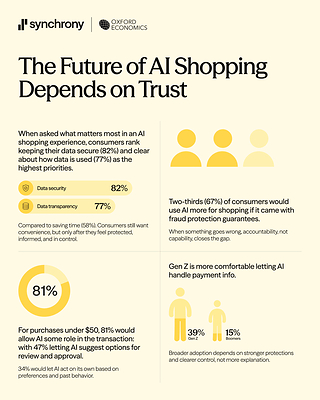
- Security and transparency matter most: Keeping data secure (82%) and being transparent about how it is used (77%) matter more to consumers than saving time (58%).
- Fraud protection drives adoption: 67% would use AI more if it included fraud protection.
- AI comfort is highest for low-risk purchases: For purchases under $50, 47% of consumers would let AI suggest options for review and approval and 34% would let AI act based on preferences and past behavior, but 46% would not use AI for purchases of $5,000 or more.
- AI shopping is becoming a trust challenge for commerce: As AI agents take on more of the shopping journey, companies will need to communicate clearly the value, protections and controls they offer consumers.
STAMFORD, Conn., Sept. 30, 2026 /PRNewswire/ -- Synchrony (NYSE: SYF), a leading consumer financing company, today released findings from its 2026 AI in Commerce study, conducted with Oxford Economics, on how consumers view AI in online shopping and payments as agentic commerce gains ground. In agentic commerce, AI agents can search, compare, and, in some cases, buy on a consumer's behalf.
The research shows many consumers already use AI for shopping, but trust determines how much they will empower an agent to act on their behalf. Shoppers are most comfortable using AI for lower-risk tasks such as searching for products, comparing prices and applying discounts. As AI moves closer to higher-value purchases, consumers want stronger security, transparency, control and a clear way to correct mistakes.
"Consumers are telling us the future of AI shopping will be won by the most trusted experience," said Nimrod Barak, Chief AI Officer of Synchrony. "As AI moves from helping shoppers compare to acting on their behalf, trust becomes the real differentiator. The companies that build protection, approval and accountability from the start will be better positioned to earn consumer confidence, drive growth and win in AI commerce."
"Consumers are open to AI taking on more of the shopping journey, but that willingness comes with clear expectations around security, transparency and control," said Margaux McLoughlin, Research Manager, Thought Leadership at Oxford Economics. "Our research shows that trust is a prerequisite for agentic commerce adoption. As AI moves from helping consumers make decisions to acting on their behalf, businesses have an opportunity to build trust into every interaction by giving consumers clear protections, visibility into how AI acts and meaningful control over the shopping experience."
Key Findings
Consumers are clear about what they want from AI shopping. Keeping data secure (82%) ranks first followed by transparency about how data is used (77%). Saving time (58%) ranks lower.
Fraud protection is a major adoption driver. Two-thirds of consumers (67%) say they would use AI more if it came with fraud protection.
Consumers are most likely to turn to AI when it helps them search, compare and save. Among those surveyed:
- 79% are willing to let AI automatically apply discounts, and 74% are willing to let AI apply loyalty points or rewards.
- 51% are open to AI recommending a new credit card, and 48% are open to AI checking whether they are prequalified.
- 43% are comfortable letting AI purchase up to a preset limit.
- 37% are comfortable allowing AI to automatically purchase regularly used products.
Trust is also shaped by existing relationships. Consumers say they would be likely to trust an AI shopping assistant from a technology company (58%), retailer or brand (56%), general AI platform (55%) or their primary bank (55%). A bank with no existing relationship trails at 38%.
AI comfort is strongest when AI is transacting on low-risk purchases. Consumers are most open to letting AI transact on lower-cost purchases. For items under $50, 47% of consumers would let AI suggest options for review and approval, and 34% would let AI act automatically based on their preferences and past behavior. By contrast, 46% would not use AI for purchases of $5,000 or more.
AI users are more willing to delegate. Consumers already using AI are less likely than non-users to cite a preference for making shopping decisions themselves as a barrier to AI use (34% vs. 52%), indicating they are more willing to delegate making or completing purchases to AI.
Younger consumers are leading adoption. Gen Z (39%) respondents are more willing than Boomers (15%) to let AI handle payment details. The report shows that stronger protections and clearer controls will be key to building trust and encouraging wider use.
What Businesses Should Do Now
The research points to a clear takeaway for retailers, brands and financial institutions: AI adoption will depend in large part on consumer trust. Companies that build AI experiences around protection, transparency and consumer control will be better positioned to earn confidence for more advanced AI shopping.
Businesses should:
- Lead with protection: Put fraud prevention, consent and recourse front and center.
- Keep consumers in control: Build review, approval and overrides into key actions.
- Start with low-risk tasks: Focus first on search, comparison, tips and discounts.
- Build on trusted relationships: Embed AI in brands, banks and platforms consumers already use.
- Plan for mistakes: Make it easy to see what the AI agent did, understand why it acted and resolve issues quickly.
Helping Brands Earn Preference When AI Agents Shop
Synchrony is putting these principles into practice by helping partners prepare for agentic commerce. The company is developing capabilities designed to make financing, rewards and offers recognizable and reliable when AI agents shop on a customer's behalf, helping brands compete on more than price.
For customers, that means a familiar and trusted experience where the value, protections and choices they expect still show up, even when an AI agent is helping them shop.
Synchrony is also working with open-source and industry groups to advance interoperable standards and help embed fraud protection, transparency, consumer control and accountability into emerging AI shopping experiences. By building and learning alongside partners, Synchrony aims to help build an AI commerce ecosystem that creates value for brands while protecting customers.
For more information, view the Synchrony and Oxford Economics 2026 AI in Commerce study and thought leadership piece.
Frequently Asked Questions
Q1: What is the significance of this research?
A1: It identifies what earns consumer confidence in AI shopping and what expands it. Consumers use AI to research, compare and find savings, and the research shows that protection, control and accountability could extend that willingness to the point of payment.
Q2: What kinds of shopping tasks are consumers already using AI for?
A2: Mostly research and comparison. About a third have used AI to search for alternatives, and a similar share to compare prices.
Q3: What would make consumers use AI more for shopping?
A3: Fraud protection. Two-thirds of consumers say they would use AI more if it came with it, and consumers rank data security and transparency above convenience.
Q4: How is Synchrony helping partners prepare for agentic commerce?
A4: Synchrony is developing capabilities designed to make financing, rewards and offers recognizable and reliable when AI agents shop on a customer's behalf. The goal is to help partners compete on more than price while giving customers a familiar, trusted experience where the value, protections and choices they expect still show up.
Q5: Why do standards matter in AI shopping?
A5: As AI agents begin helping consumers search, compare and buy, brands, financial institutions and technology platforms will need common ways to support transparency, fraud protection, consumer control and accountability. Synchrony is working with open-source and industry groups to help advance interoperable standards that can support trusted AI shopping experiences.
Q6: Where can I learn more?
A6: Learn more about Synchrony and agentic commerce here.
About Synchrony
Synchrony (NYSE: SYF) is a leading consumer financing company that has been at the heart of American commerce and opportunity for nearly a century. Synchrony delivers credit and banking products that empower tens of millions of consumers to improve their financial lives and access what matters most. Leveraging innovative solutions that are shaping the future of retail commerce, Synchrony supports the growth and success of some of the nation's most respected brands, alongside hundreds of thousands of small and midsize businesses, including health and wellness providers. Committed to excellence in service and culture, Synchrony is honored to be ranked the #1 Best Company to Work For® in the U.S. by Fortune magazine and Great Place to Work®. For more information, visit www.synchrony.com.
Methodology: This study pairs a survey of 2,000 U.S. consumers, fielded in May 2026, with eight in-depth interviews with senior payments, retail and technology leaders, conducted in partnership with Oxford Economics.
Media Contact
Angie Hu
Angie.Hu@syf.com

 View original content to download multimedia:https://www.prnewswire.com/news-releases/synchrony-and-oxford-economics-find-trust-will-define-the-future-of-ai-shopping-302894036.html
SOURCE Synchrony Financial
Released September 30, 2026