January 27, 2026 FOURTH QUARTER 2025 FINANCIAL RESULTS Exhibit 99.3
2 Disclaimers Cautionary Statement Regarding Forward-Looking Statements The following slides are part of a presentation by Synchrony Financial in connection with reporting quarterly financial results and should be read in conjunction with the earnings release and financial supplement included as exhibits to our Current Report on Form 8-K filed today and available on our website (www.investors.synchrony.com) and the SEC's website (www.sec.gov). All references to net earnings and net income are intended to have the same meaning. All comparisons are for the fourth quarter of 2025 compared to the fourth quarter of 2024, unless otherwise noted. This presentation contains certain forward-looking statements as defined in Section 27A of the Securities Act of 1933, as amended, and Section 21E of the Securities Exchange Act of 1934, as amended, which are subject to the "safe harbor" created by those sections. Forward-looking statements may be identified by words such as "expects," "intends," "anticipates," "plans," "believes," "seeks," "targets," "outlook," "estimates," "will," "should," "may," “aim,” “focus,” “goal,” “confident,” “trajectory,” "priorities," "designed," "consider" or words of similar meaning, but these words are not the exclusive means of identifying forward-looking statements. Forward-looking statements are based on management's current expectations and assumptions, and are subject to inherent uncertainties, risks and changes in circumstances that are difficult to predict. As a result, actual results could differ materially from those indicated in these forward-looking statements. Factors that could cause actual results to differ materially include global political, economic, business, competitive, market, regulatory and other factors and risks, such as: the impact of macroeconomic conditions, including factors impacting consumer confidence and economic growth in the United States, such as inflation, interest rates, tariffs (including retaliatory tariffs) and an economic downturn or recession, and whether industry trends we have identified develop as anticipated; the impact of changes made or influenced by the U.S. presidential administration and Congress on fiscal, monetary and regulatory policy, including with respect to constraints on the pricing of our credit products; the impact of the federal government shutdown in October and November 2025; retaining existing partners and attracting new partners, concentration of our revenue in a small number of partners, and promotion and support of our products by our partners; cyber-attacks or other security incidents or breaches; disruptions in the operations of our and our outsourced partners' computer systems and data centers; the financial performance of our partners; product, pricing, and policy changes related to the Consumer Financial Protection Bureau’s (the “CFPB”) final rule on credit card late fees, which was vacated in April 2025; the sufficiency of our allowance for credit losses and the accuracy of the assumptions or estimates used in preparing our financial statements, including those related to the CECL accounting guidance; higher borrowing costs and adverse financial market conditions impacting our funding and liquidity, and any reduction in our credit ratings; our ability to grow our deposits in the future; damage to our reputation; our ability to securitize our loan receivables, occurrence of an early amortization of our securitization facilities, loss of the right to service or subservice our securitized loan receivables, and lower payment rates on our securitized loan receivables; changes in benchmark or market interest rates; effectiveness of our risk management processes and procedures, reliance on models which may be inaccurate or misinterpreted, and our ability to manage our credit risk; our ability to offset increases in our costs in retailer share arrangements; competition in the consumer finance industry; our concentration in the U.S. consumer credit market and susceptibility to market fluctuations and legislative and regulatory developments; our ability to successfully develop and commercialize new or enhanced products and services; our ability to realize the value of acquisitions, dispositions and strategic investments; reductions in interchange fees; fraudulent activity; failure of third-parties to provide various services that are important to our operations; international risks and compliance and regulatory risks and costs associated with international operations; alleged infringement of intellectual property rights of others and our ability to protect our intellectual property; litigation, regulatory actions and compliance issues; our ability to attract, retain and motivate key officers and employees; tax legislation initiatives or challenges to our tax positions and/or interpretations, and state sales tax rules and regulations; regulation, supervision, examination and enforcement of our business by governmental authorities, the impact of the Dodd-Frank Wall Street Reform and Consumer Protection Act and other legislative and regulatory developments and the impact of the CFPB’s regulation of our business, including new requirements and constraints the Company and the Bank are or will become subject to as a result of having $100 billion or more in total assets; impact of capital adequacy rules and liquidity requirements; restrictions that limit our ability to pay dividends and repurchase our common stock, and restrictions that limit the Bank’s ability to pay dividends to us; regulations relating to privacy, information security and data protection; use of third-party vendors and ongoing third-party business relationships; and failure to comply with anti-money laundering and anti-terrorism financing laws. For the reasons described above, we caution you against relying on any forward-looking statements, which should also be read in conjunction with the other cautionary statements that are included elsewhere in this presentation and in our public filings, including under the headings “Risk Factors Relating to Our Business” and “Risk Factors Relating to Regulation” in the Company's most recent Annual Report on Form 10-K. You should not consider any list of such factors to be an exhaustive statement of all the risks, uncertainties, or potentially inaccurate assumptions that could cause our current expectations or beliefs to change. Further, any forward-looking statement speaks only as of the date on which it is made, and we undertake no obligation to update or revise any forward-looking statement, including the 2026 outlook on slide 11 of this presentation, to reflect events or circumstances after the date on which the statement is made or to reflect the occurrence of unanticipated events, except as otherwise may be required by law.
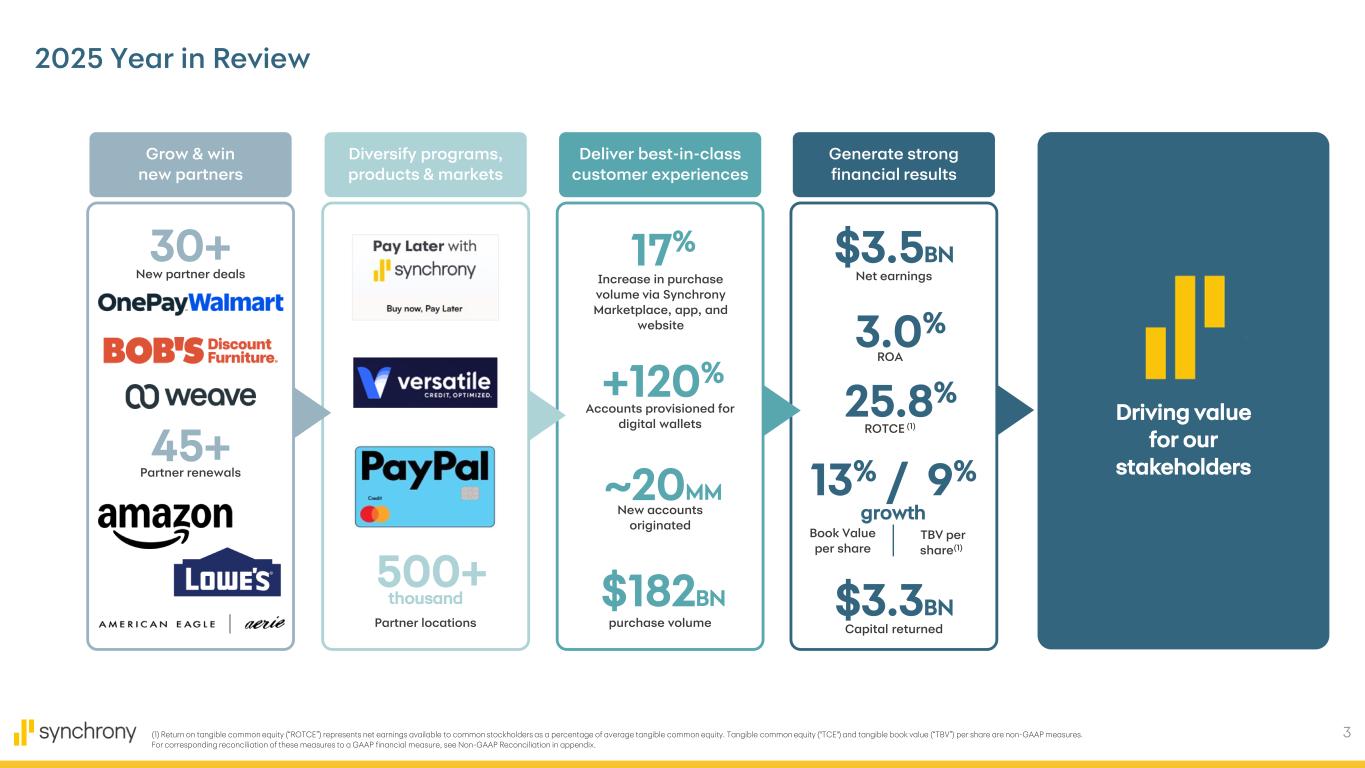
3 3.0% 2025 Year in Review $3.5BN Grow & win new partners New partner deals +120% Accounts provisioned for digital wallets 45+ Partner renewals $182BN purchase volume 500+ 17% Increase in purchase volume via Synchrony Marketplace, app, and website Partner locations thousand Capital returned ROA ROTCE (1) Net earnings $3.3BN Driving value for our stakeholders Diversify programs, products & markets Deliver best-in-class customer experiences Generate strong financial results 30+ ~20MM New accounts originated Book Value per share 13% / 9% growth (1) Return on tangible common equity (“ROTCE”) represents net earnings available to common stockholders as a percentage of average tangible common equity. Tangible common equity ("TCE") and tangible book value (“TBV”) per share are non-GAAP measures. For corresponding reconciliation of these measures to a GAAP financial measure, see Non-GAAP Reconciliation in appendix. 25.8% TBV per share(1)
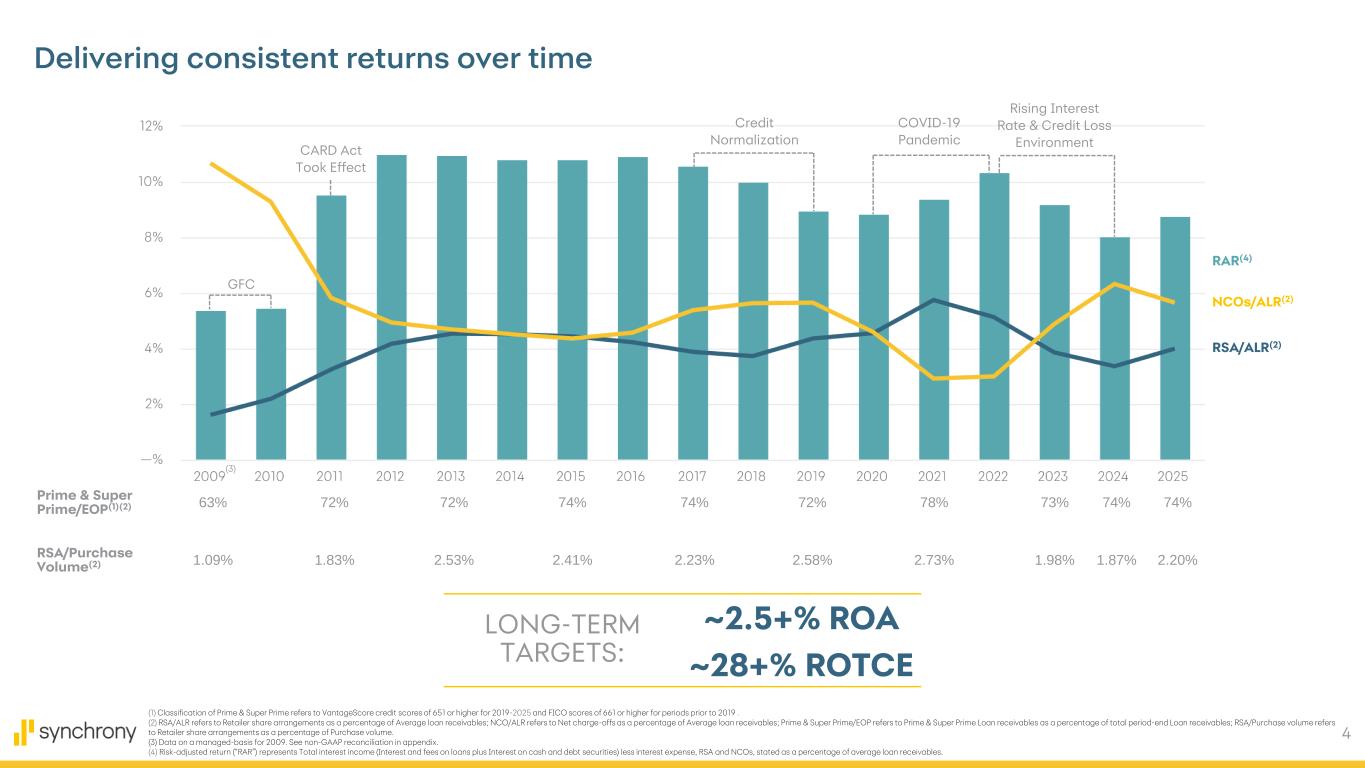
4 Delivering consistent returns over time Prime & Super Prime/EOP(1)(2) 63% 72% 72% 74% 74% 72% 78% 73% 74% 74% RSA/Purchase Volume(2) 1.09% 1.83% 2.53% 2.41% 2.23% 2.58% 2.73% 1.98% 1.87% 2.20% LONG-TERM TARGETS: ~2.5+% ROA ~28+% ROTCE NCOs/ALR(2) RAR(4) RSA/ALR(2) (1) Classification of Prime & Super Prime refers to VantageScore credit scores of 651 or higher for 2019-2025 and FICO scores of 661 or higher for periods prior to 2019 . (2) RSA/ALR refers to Retailer share arrangements as a percentage of Average loan receivables; NCO/ALR refers to Net charge-offs as a percentage of Average loan receivables; Prime & Super Prime/EOP refers to Prime & Super Prime Loan receivables as a percentage of total period-end Loan receivables; RSA/Purchase volume refers to Retailer share arrangements as a percentage of Purchase volume. (3) Data on a managed-basis for 2009. See non-GAAP reconciliation in appendix. (4) Risk-adjusted return (“RAR”) represents Total interest income (Interest and fees on loans plus Interest on cash and debt securities) less interest expense, RSA and NCOs, stated as a percentage of average loan receivables. CARD Act Took Effect Credit Normalization COVID-19 Pandemic Rising Interest Rate & Credit Loss Environment GFC (3)
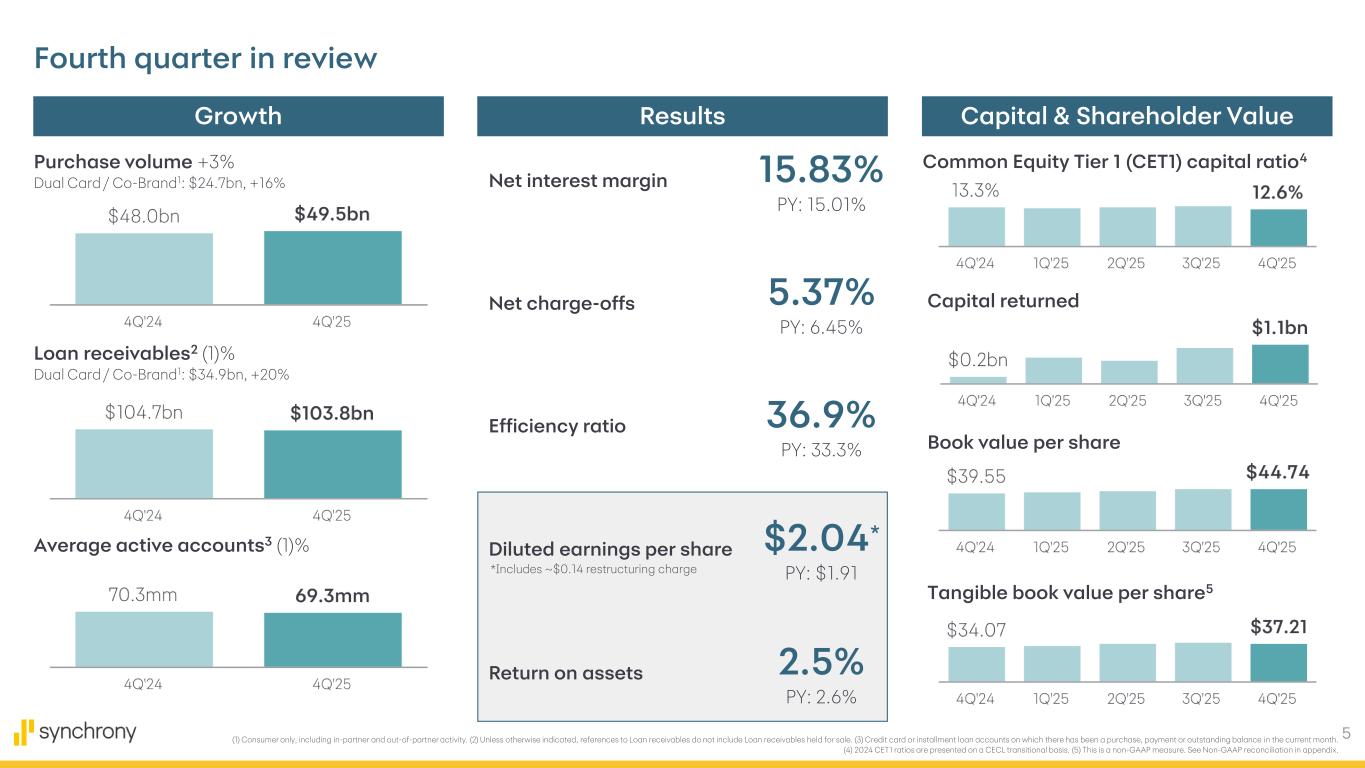
5 Net interest margin 15.83% PY: 15.01% Net charge-offs 5.37% PY: 6.45% Efficiency ratio 36.9% PY: 33.3% Diluted earnings per share $2.04* PY: $1.91 Return on assets 2.5% PY: 2.6% Fourth quarter in review (1) Consumer only, including in-partner and out-of-partner activity. (2) Unless otherwise indicated, references to Loan receivables do not include Loan receivables held for sale. (3) Credit card or installment loan accounts on which there has been a purchase, payment or outstanding balance in the current month. (4) 2024 CET1 ratios are presented on a CECL transitional basis. (5) This is a non-GAAP measure. See Non-GAAP reconciliation in appendix. Growth Results Capital & Shareholder Value Loan receivables2 (1)% Dual Card / Co-Brand1: $34.9bn, +20% Book value per share Tangible book value per share5 Average active accounts3 (1)% Common Equity Tier 1 (CET1) capital ratio4 Capital returned *Includes ~$0.14 restructuring charge Purchase volume +3% Dual Card / Co-Brand1: $24.7bn, +16%
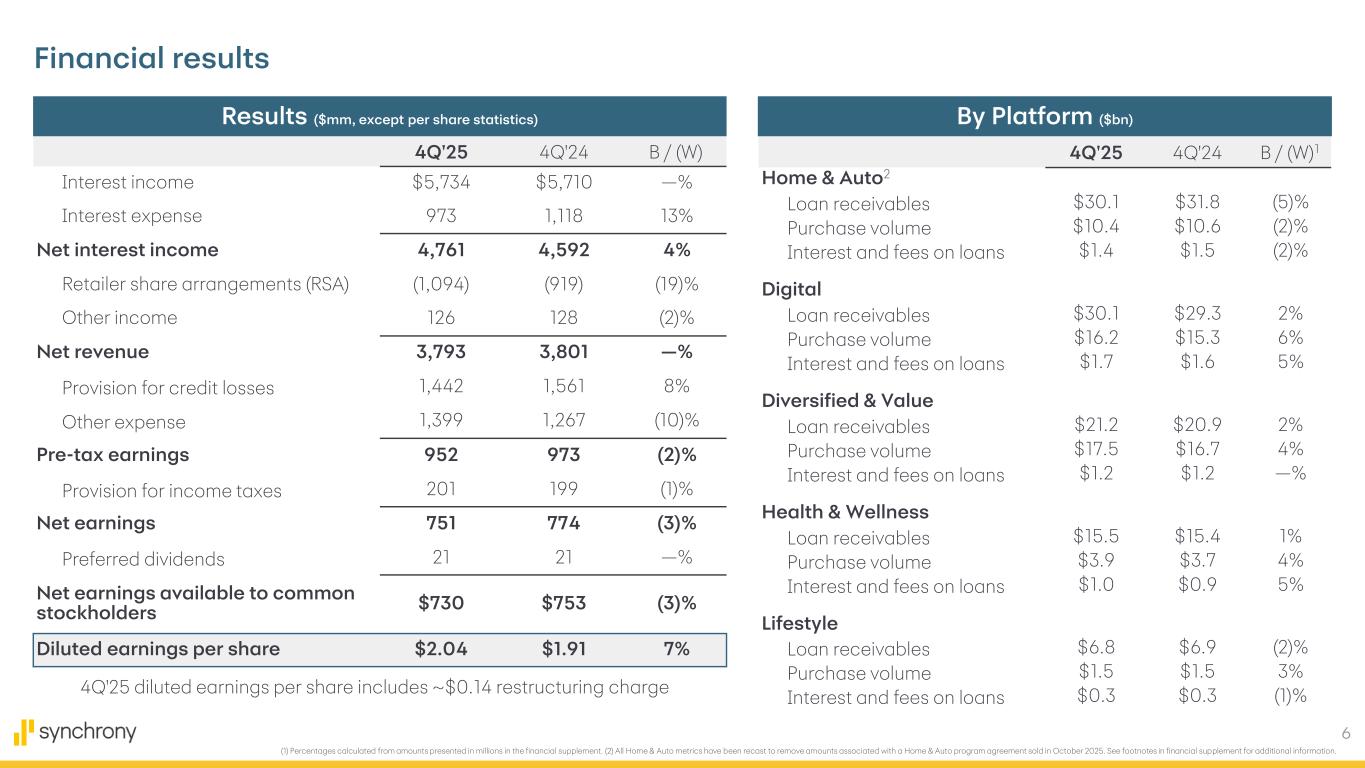
6 (1) Percentages calculated from amounts presented in millions in the financial supplement. (2) All Home & Auto metrics have been recast to remove amounts associated with a Home & Auto program agreement sold in October 2025. See footnotes in financial supplement for additional information. Financial results Results ($mm, except per share statistics) By Platform ($bn) 4Q'25 4Q'24 B / (W) Interest income $5,734 $5,710 —% Interest expense 973 1,118 13% Net interest income 4,761 4,592 4% Retailer share arrangements (RSA) (1,094) (919) (19)% Other income 126 128 (2)% Net revenue 3,793 3,801 —% Provision for credit losses 1,442 1,561 8% Other expense 1,399 1,267 (10)% Pre-tax earnings 952 973 (2)% Provision for income taxes 201 199 (1)% Net earnings 751 774 (3)% Preferred dividends 21 21 —% Net earnings available to common stockholders $730 $753 (3)% Diluted earnings per share $2.04 $1.91 7% 4Q'25 4Q'24 B / (W)1 Home & Auto2 Loan receivables $30.1 $31.8 (5)% Purchase volume $10.4 $10.6 (2)% Interest and fees on loans $1.4 $1.5 (2)% Digital Loan receivables $30.1 $29.3 2% Purchase volume $16.2 $15.3 6% Interest and fees on loans $1.7 $1.6 5% Diversified & Value Loan receivables $21.2 $20.9 2% Purchase volume $17.5 $16.7 4% Interest and fees on loans $1.2 $1.2 —% Health & Wellness Loan receivables $15.5 $15.4 1% Purchase volume $3.9 $3.7 4% Interest and fees on loans $1.0 $0.9 5% Lifestyle Loan receivables $6.8 $6.9 (2)% Purchase volume $1.5 $1.5 3% Interest and fees on loans $0.3 $0.3 (1)%4Q'25 diluted earnings per share includes ~$0.14 restructuring charge
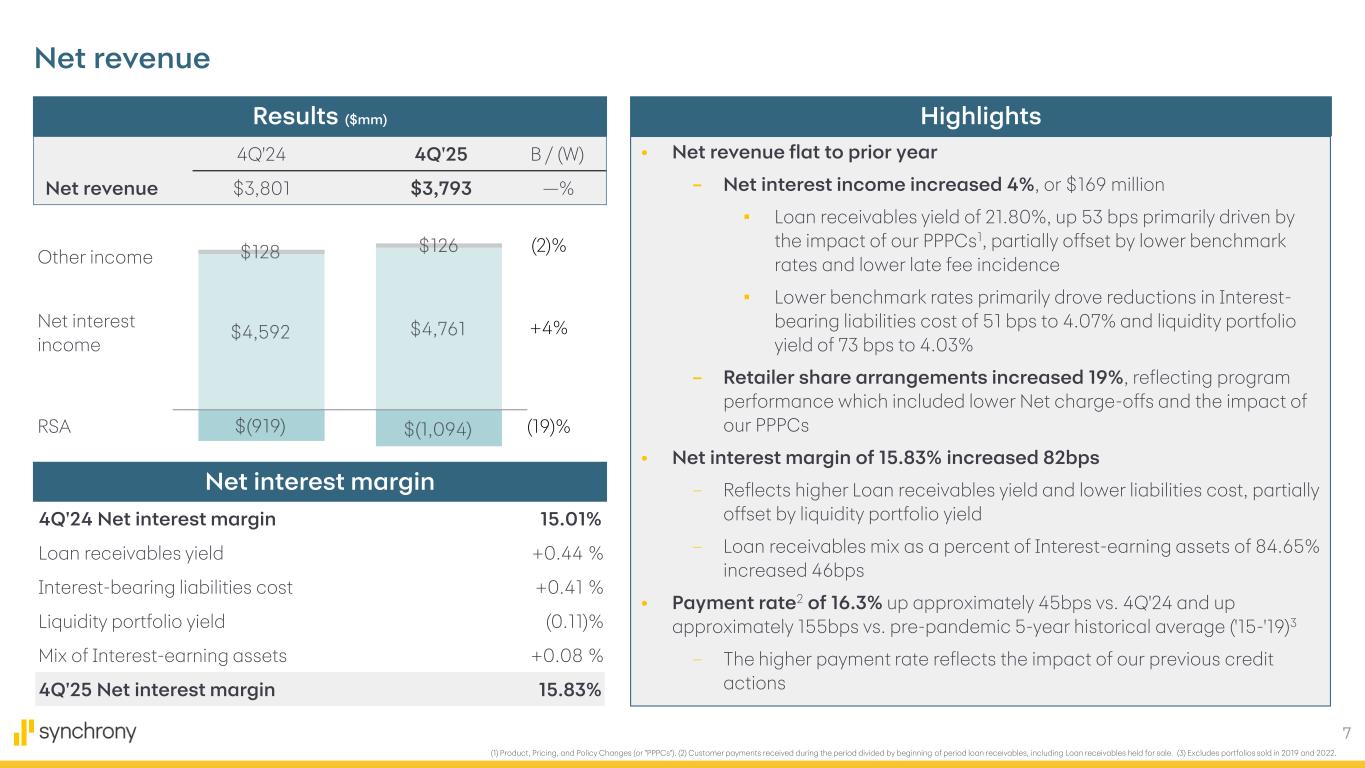
7 (1) Product, Pricing, and Policy Changes (or "PPPCs"). (2) Customer payments received during the period divided by beginning of period loan receivables, including Loan receivables held for sale. (3) Excludes portfolios sold in 2019 and 2022. • Net revenue flat to prior year – Net interest income increased 4%, or $169 million ▪ Loan receivables yield of 21.80%, up 53 bps primarily driven by the impact of our PPPCs1, partially offset by lower benchmark rates and lower late fee incidence ▪ Lower benchmark rates primarily drove reductions in Interest- bearing liabilities cost of 51 bps to 4.07% and liquidity portfolio yield of 73 bps to 4.03% – Retailer share arrangements increased 19%, reflecting program performance which included lower Net charge-offs and the impact of our PPPCs • Net interest margin of 15.83% increased 82bps – Reflects higher Loan receivables yield and lower liabilities cost, partially offset by liquidity portfolio yield – Loan receivables mix as a percent of Interest-earning assets of 84.65% increased 46bps • Payment rate2 of 16.3% up approximately 45bps vs. 4Q'24 and up approximately 155bps vs. pre-pandemic 5-year historical average ('15-'19)3 – The higher payment rate reflects the impact of our previous credit actions Net revenue Results ($mm) Highlights Other income Net interest income RSA (2)% +4% (19)% 4Q'24 Net interest margin 15.01% Loan receivables yield +0.44 % Interest-bearing liabilities cost +0.41 % Liquidity portfolio yield (0.11)% Mix of Interest-earning assets +0.08 % 4Q'25 Net interest margin 15.83% Net interest margin 4Q'24 4Q'25 B / (W) Net revenue $3,801 $3,793 —%
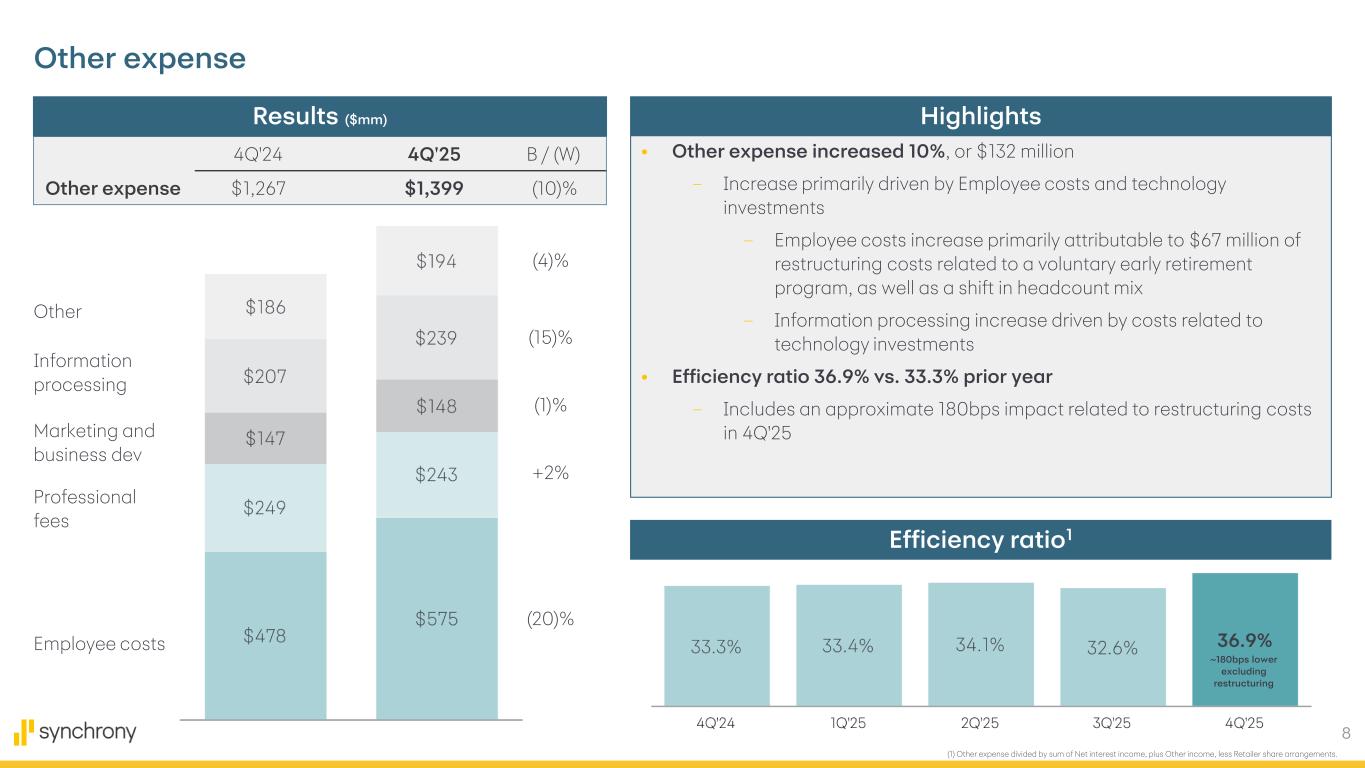
8 (1) Other expense divided by sum of Net interest income, plus Other income, less Retailer share arrangements. 4Q'24 4Q'25 B / (W) Other expense $1,267 $1,399 (10)% Other expense Marketing and business dev Professional fees Results ($mm) Highlights Employee costs (1)% +2% (20)% Information processing (15)% Other (4)% Efficiency ratio1 • Other expense increased 10%, or $132 million – Increase primarily driven by Employee costs and technology investments – Employee costs increase primarily attributable to $67 million of restructuring costs related to a voluntary early retirement program, as well as a shift in headcount mix – Information processing increase driven by costs related to technology investments • Efficiency ratio 36.9% vs. 33.3% prior year – Includes an approximate 180bps impact related to restructuring costs in 4Q'25 ~180bps lower excluding restructuring
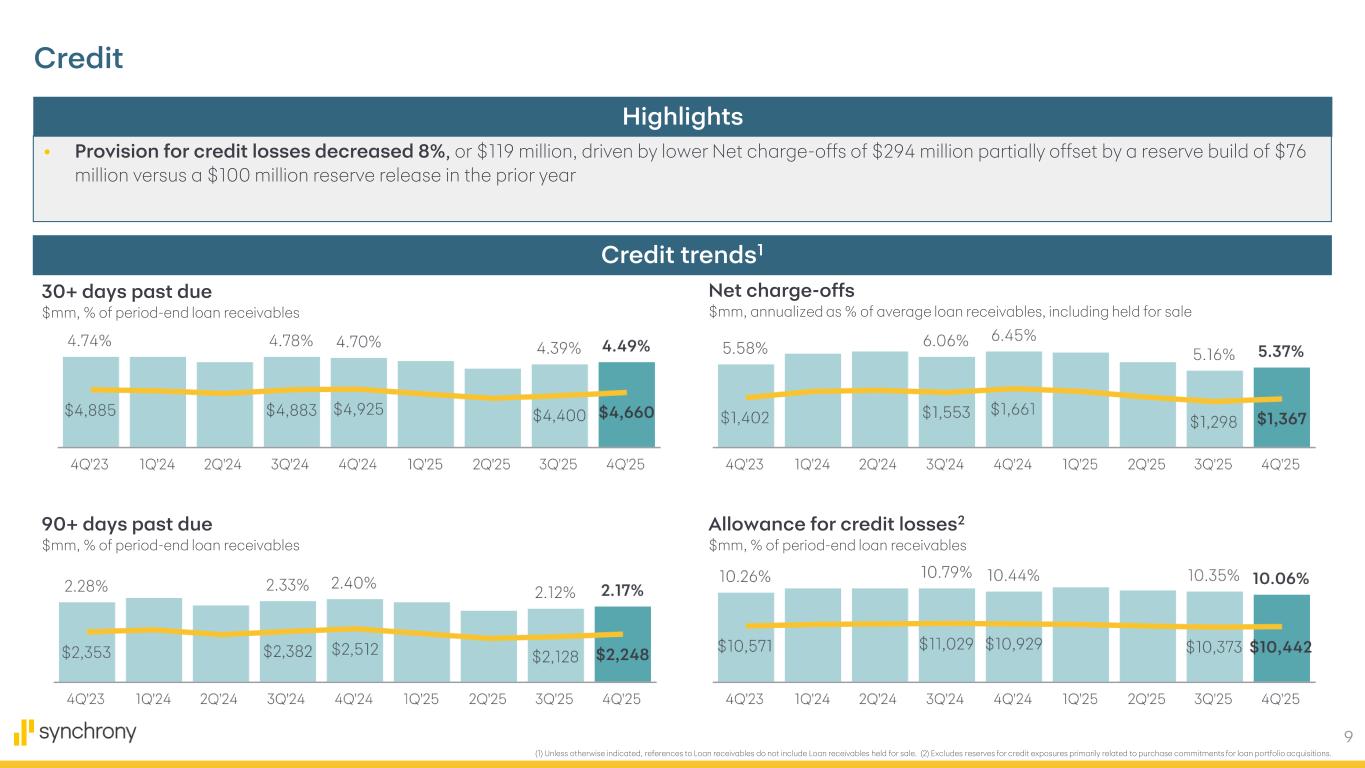
9 • Provision for credit losses decreased 8%, or $119 million, driven by lower Net charge-offs of $294 million partially offset by a reserve build of $76 million versus a $100 million reserve release in the prior year (1) Unless otherwise indicated, references to Loan receivables do not include Loan receivables held for sale. (2) Excludes reserves for credit exposures primarily related to purchase commitments for loan portfolio acquisitions. Highlights Credit 30+ days past due $mm, % of period-end loan receivables 90+ days past due $mm, % of period-end loan receivables Net charge-offs $mm, annualized as % of average loan receivables, including held for sale Allowance for credit losses2 $mm, % of period-end loan receivables Credit trends1
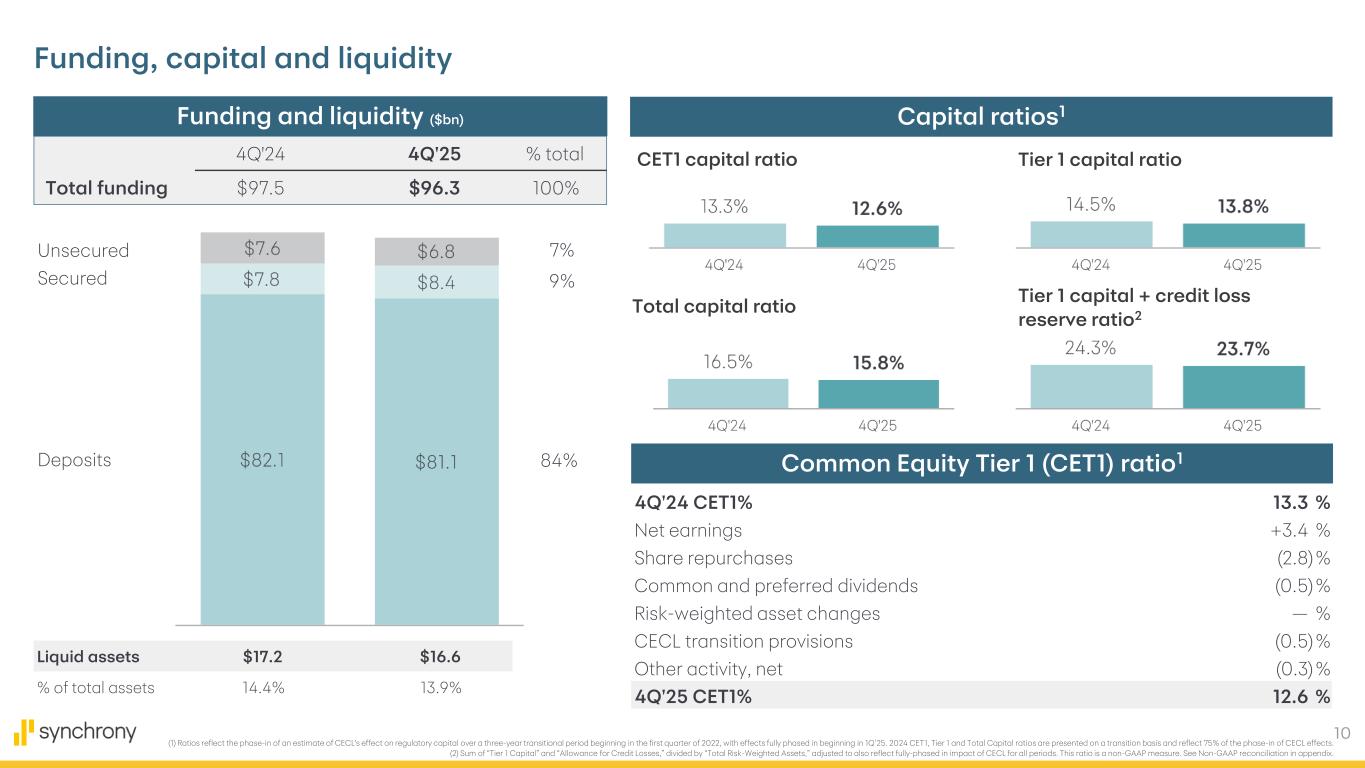
10 4Q'24 CET1% 13.3 % Net earnings +3.4 % Share repurchases (2.8)% Common and preferred dividends (0.5)% Risk-weighted asset changes — % CECL transition provisions (0.5)% Other activity, net (0.3)% 4Q'25 CET1% 12.6 % Funding, capital and liquidity Funding and liquidity ($bn) Common Equity Tier 1 (CET1) ratio1 (1) Ratios reflect the phase-in of an estimate of CECL's effect on regulatory capital over a three-year transitional period beginning in the first quarter of 2022, with effects fully phased in beginning in 1Q’25. 2024 CET1, Tier 1 and Total Capital ratios are presented on a transition basis and reflect 75% of the phase-in of CECL effects. (2) Sum of “Tier 1 Capital” and “Allowance for Credit Losses,” divided by “Total Risk-Weighted Assets,” adjusted to also reflect fully-phased in impact of CECL for all periods. This ratio is a non-GAAP measure. See Non-GAAP reconciliation in appendix. Unsecured Secured Deposits 7% 9% 84% Capital ratios1 CET1 capital ratio Tier 1 capital ratio Total capital ratio Tier 1 capital + credit loss reserve ratio2 Liquid assets $17.2 $16.6 % of total assets 14.4% 13.9% 4Q'24 4Q'25 % total Total funding $97.5 $96.3 100%
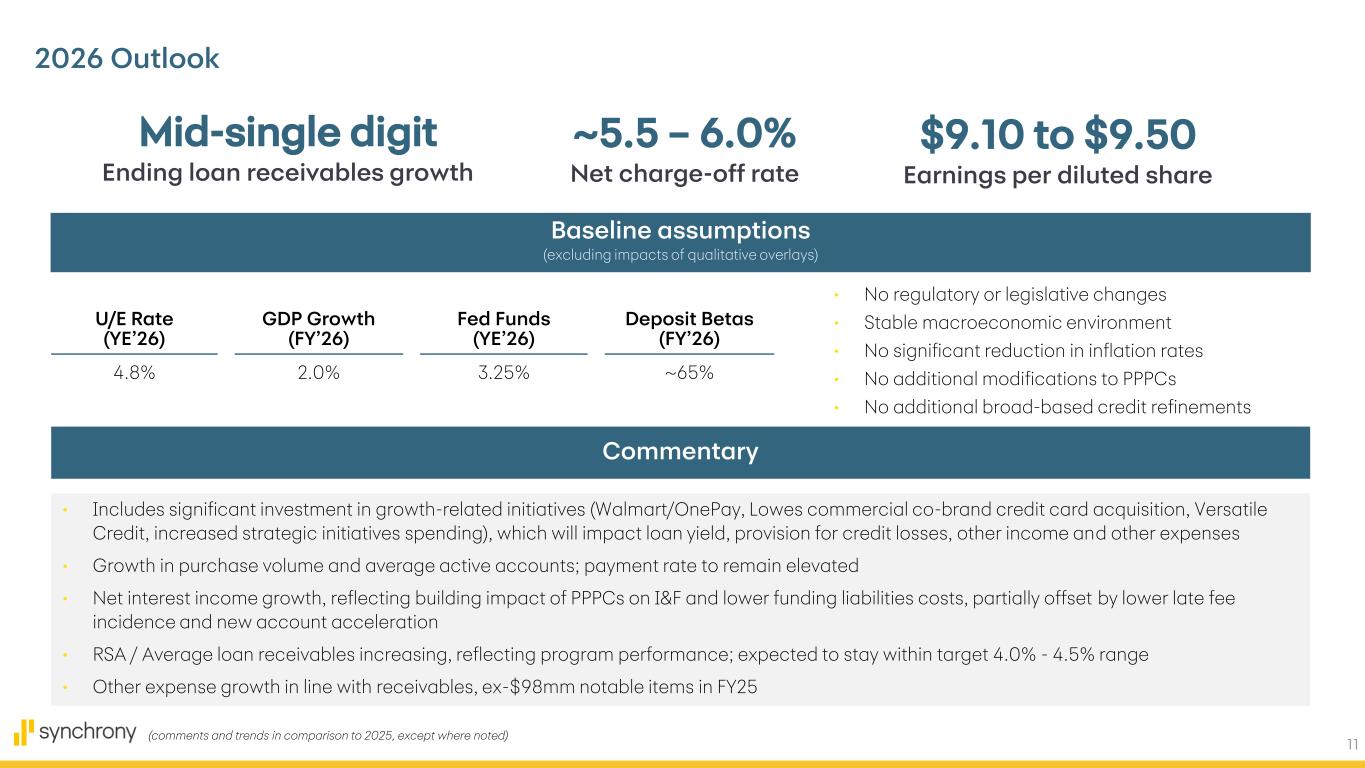
11 2026 Outlook (comments and trends in comparison to 2025, except where noted) Commentary • Includes significant investment in growth-related initiatives (Walmart/OnePay, Lowes commercial co-brand credit card acquisition, Versatile Credit, increased strategic initiatives spending), which will impact loan yield, provision for credit losses, other income and other expenses • Growth in purchase volume and average active accounts; payment rate to remain elevated • Net interest income growth, reflecting building impact of PPPCs on I&F and lower funding liabilities costs, partially offset by lower late fee incidence and new account acceleration • RSA / Average loan receivables increasing, reflecting program performance; expected to stay within target 4.0% - 4.5% range • Other expense growth in line with receivables, ex-$98mm notable items in FY25 U/E Rate (YE’26) GDP Growth (FY’26) Fed Funds (YE’26) Deposit Betas (FY’26) 4.8% 2.0% 3.25% ~65% • No regulatory or legislative changes • Stable macroeconomic environment • No significant reduction in inflation rates • No additional modifications to PPPCs • No additional broad-based credit refinements Baseline assumptions (excluding impacts of qualitative overlays) Mid-single digit Ending loan receivables growth $9.10 to $9.50 Earnings per diluted share ~5.5 – 6.0% Net charge-off rate

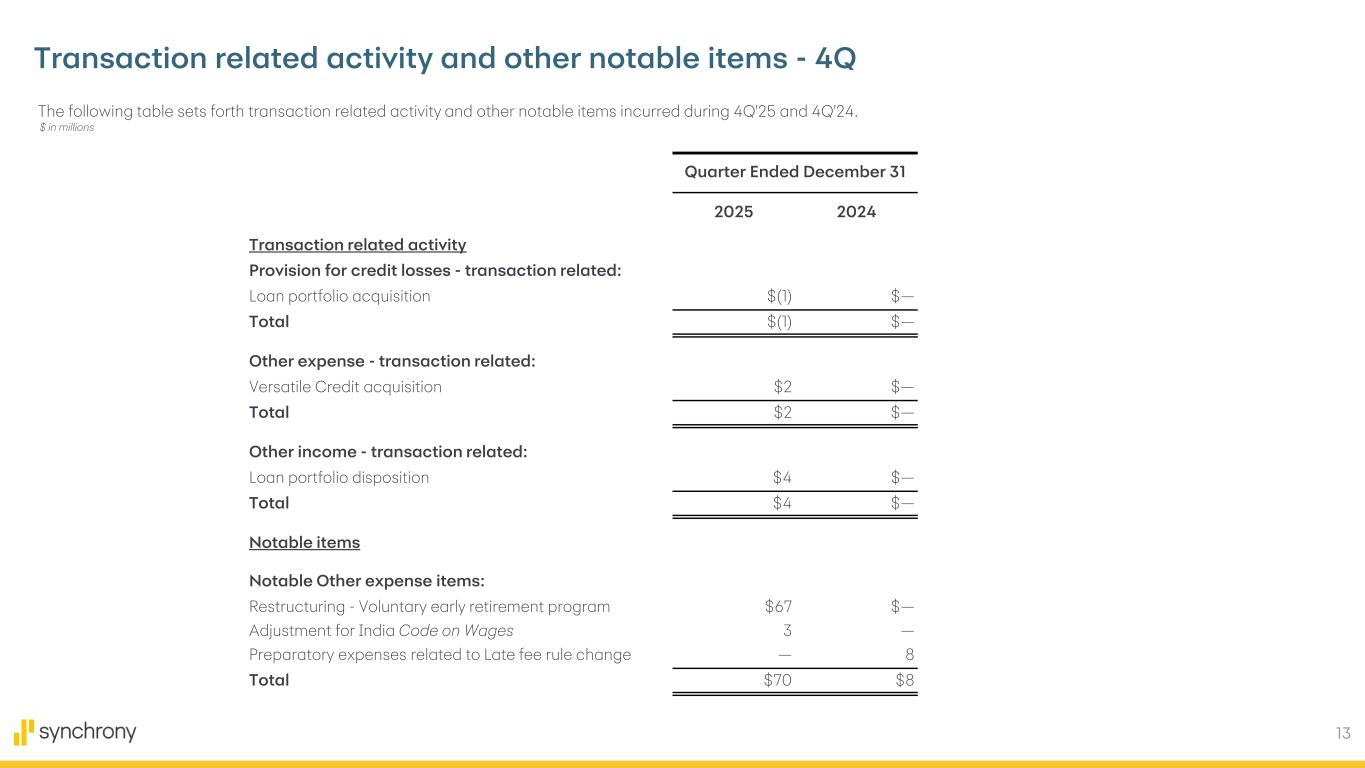
13 The following table sets forth transaction related activity and other notable items incurred during 4Q'25 and 4Q'24. Transaction related activity and other notable items - 4Q $ in millions Quarter Ended December 31 2025 2024 Transaction related activity Provision for credit losses - transaction related: Loan portfolio acquisition $(1) $— Total $(1) $— Other expense - transaction related: Versatile Credit acquisition $2 $— Total $2 $— Other income - transaction related: Loan portfolio disposition $4 $— Total $4 $— Notable items Notable Other expense items: Restructuring - Voluntary early retirement program $67 $— Adjustment for India Code on Wages 3 — Preparatory expenses related to Late fee rule change — 8 Total $70 $8
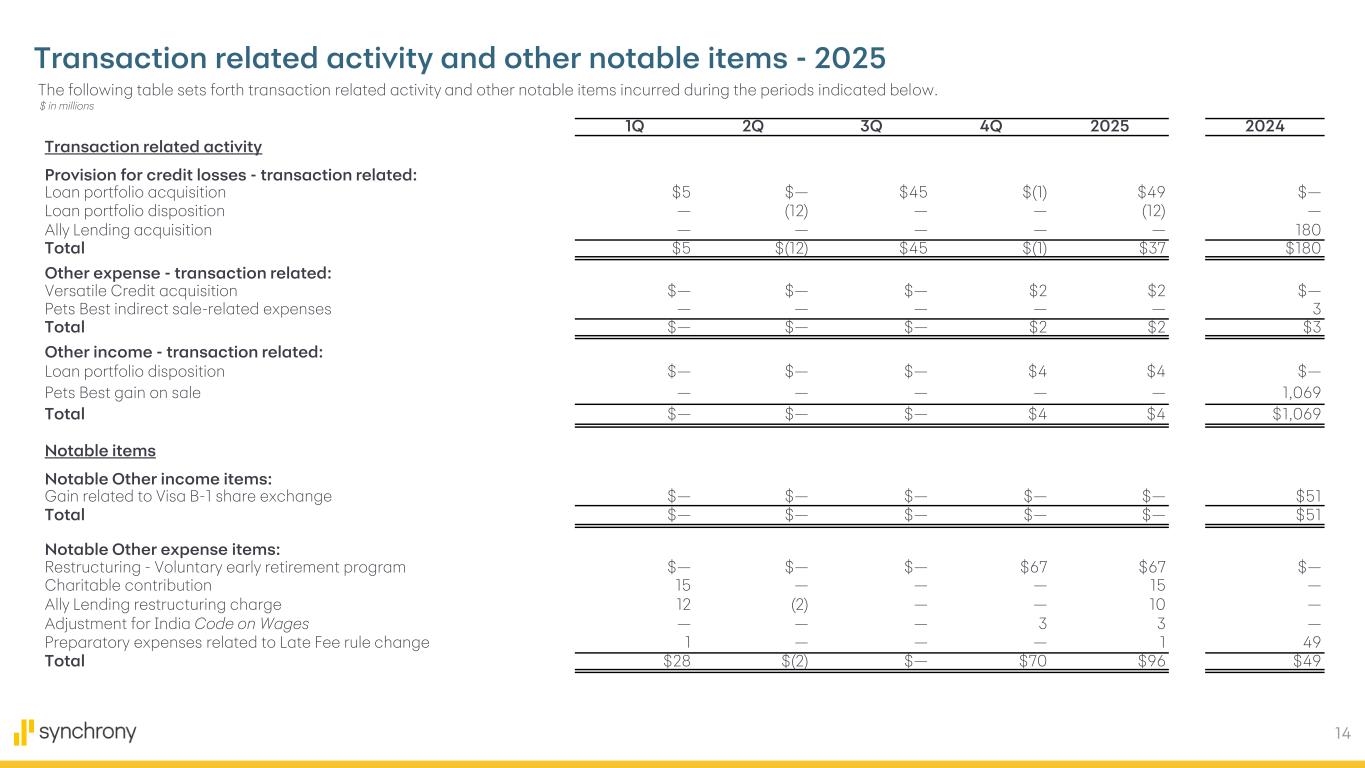
14 The following table sets forth transaction related activity and other notable items incurred during the periods indicated below. Transaction related activity and other notable items - 2025 $ in millions 1Q 2Q 3Q 4Q 2025 2024 Transaction related activity Provision for credit losses - transaction related: Loan portfolio acquisition $5 $— $45 $(1) $49 $— Loan portfolio disposition — (12) — — (12) — Ally Lending acquisition — — — — — 180 Total $5 $(12) $45 $(1) $37 $180 Other expense - transaction related: Versatile Credit acquisition $— $— $— $2 $2 $— Pets Best indirect sale-related expenses — — — — — 3 Total $— $— $— $2 $2 $3 Other income - transaction related: Loan portfolio disposition $— $— $— $4 $4 $— Pets Best gain on sale — — — — — 1,069 Total $— $— $— $4 $4 $1,069 Notable items Notable Other income items: Gain related to Visa B-1 share exchange $— $— $— $— $— $51 Total $— $— $— $— $— $51 Notable Other expense items: Restructuring - Voluntary early retirement program $— $— $— $67 $67 $— Charitable contribution 15 — — — 15 — Ally Lending restructuring charge 12 (2) — — 10 — Adjustment for India Code on Wages — — — 3 3 — Preparatory expenses related to Late Fee rule change 1 — — — 1 49 Total $28 $(2) $— $70 $96 $49
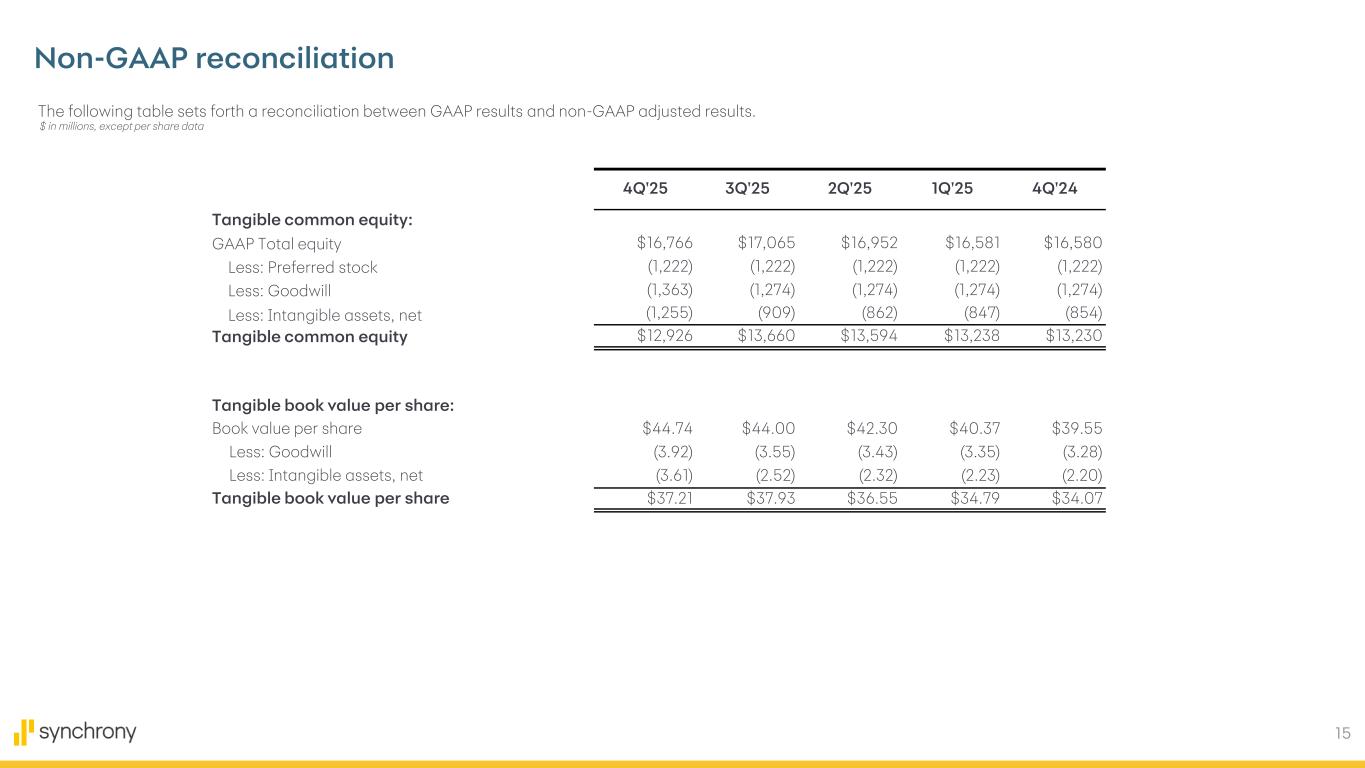
15 The following table sets forth a reconciliation between GAAP results and non-GAAP adjusted results. Non-GAAP reconciliation 4Q'25 3Q'25 2Q'25 1Q'25 4Q'24 Tangible common equity: GAAP Total equity $16,766 $17,065 $16,952 $16,581 $16,580 Less: Preferred stock (1,222) (1,222) (1,222) (1,222) (1,222) Less: Goodwill (1,363) (1,274) (1,274) (1,274) (1,274) Less: Intangible assets, net (1,255) (909) (862) (847) (854) Tangible common equity $12,926 $13,660 $13,594 $13,238 $13,230 Tangible book value per share: Book value per share $44.74 $44.00 $42.30 $40.37 $39.55 Less: Goodwill (3.92) (3.55) (3.43) (3.35) (3.28) Less: Intangible assets, net (3.61) (2.52) (2.32) (2.23) (2.20) Tangible book value per share $37.21 $37.93 $36.55 $34.79 $34.07 $ in millions, except per share data
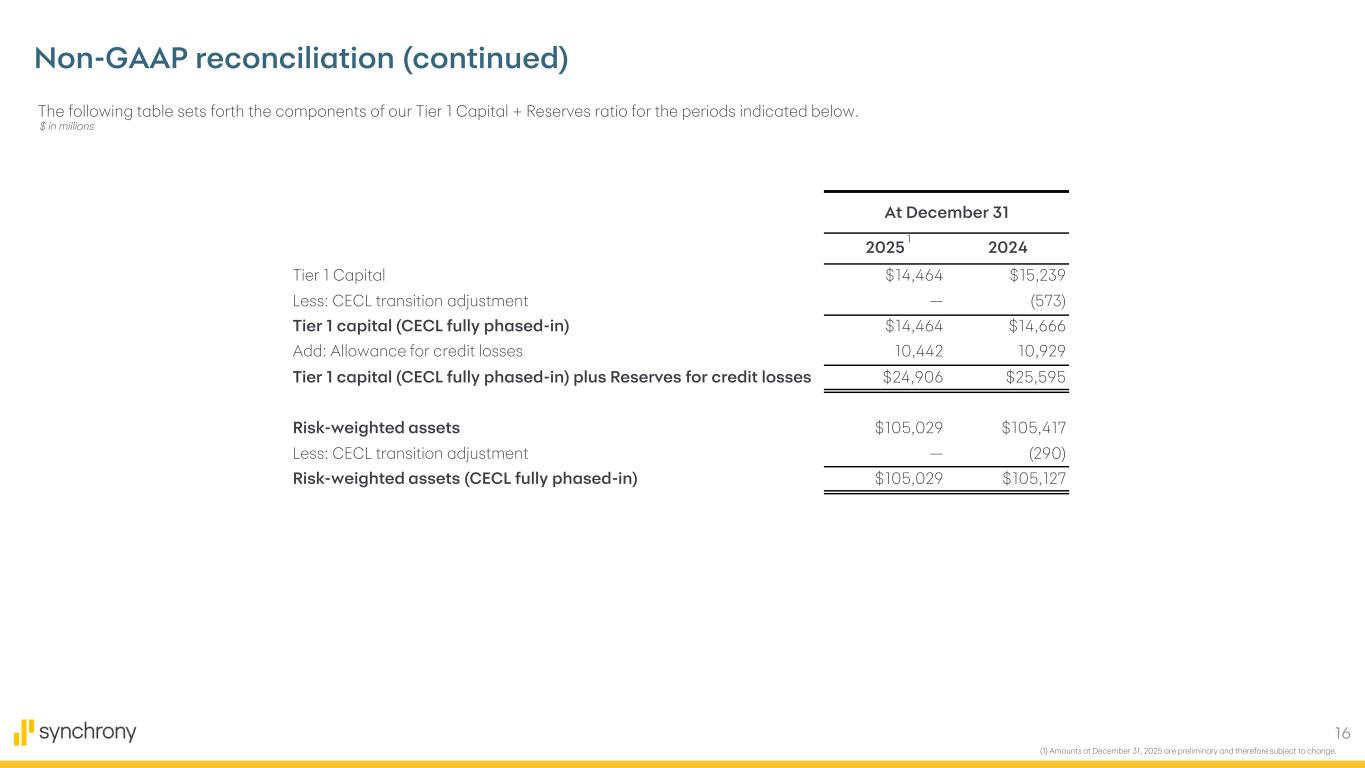
16 $ in millions Non-GAAP reconciliation (continued) At December 31 2025 2024 Tier 1 Capital $14,464 $15,239 Less: CECL transition adjustment — (573) Tier 1 capital (CECL fully phased-in) $14,464 $14,666 Add: Allowance for credit losses 10,442 10,929 Tier 1 capital (CECL fully phased-in) plus Reserves for credit losses $24,906 $25,595 Risk-weighted assets $105,029 $105,417 Less: CECL transition adjustment — (290) Risk-weighted assets (CECL fully phased-in) $105,029 $105,127 The following table sets forth the components of our Tier 1 Capital + Reserves ratio for the periods indicated below. (1) Amounts at December 31, 2025 are preliminary and therefore subject to change. 1
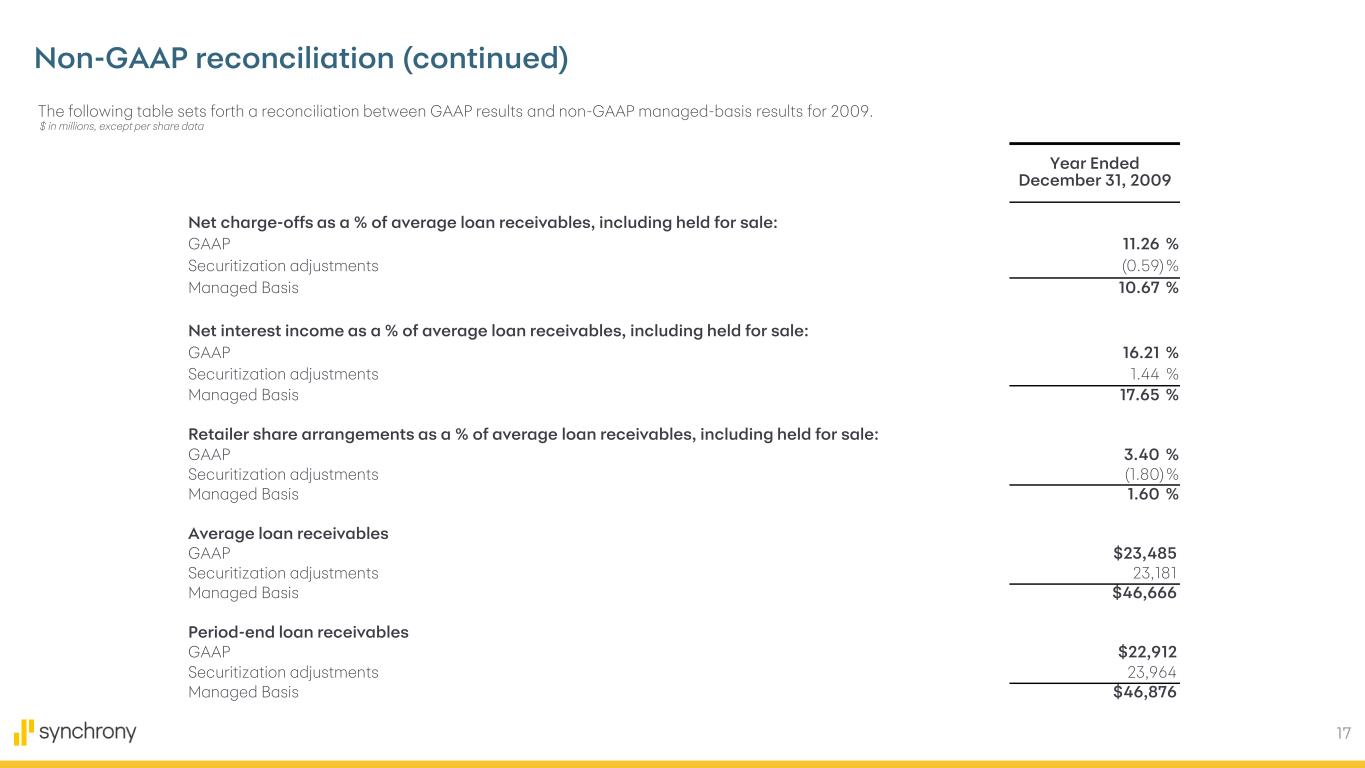
17 Non-GAAP reconciliation (continued) The following table sets forth a reconciliation between GAAP results and non-GAAP managed-basis results for 2009. $ in millions, except per share data Year Ended December 31, 2009 Net charge-offs as a % of average loan receivables, including held for sale: GAAP 11.26 % Securitization adjustments (0.59) % Managed Basis 10.67 % Net interest income as a % of average loan receivables, including held for sale: GAAP 16.21 % Securitization adjustments 1.44 % Managed Basis 17.65 % Retailer share arrangements as a % of average loan receivables, including held for sale: GAAP 3.40 % Securitization adjustments (1.80)% Managed Basis 1.60 % Average loan receivables GAAP $23,485 Securitization adjustments 23,181 Managed Basis $46,666 Period-end loan receivables GAAP $22,912 Securitization adjustments 23,964 Managed Basis $46,876